There are simple, but powerful moments, when the calendar and the sky seem to answer each other. The first full moon of the year is one of these benchmarks: a concrete milestone in the lunar cycle, and a symbolic tipping point to clarify what is starting, what continues, and what needs to be adjusted.
The full moon: an astronomical landmark, above all
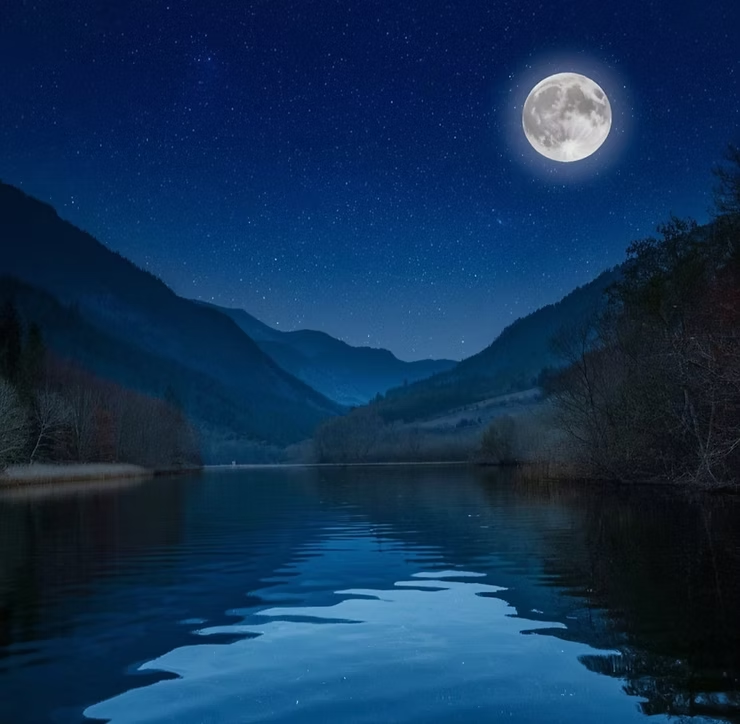
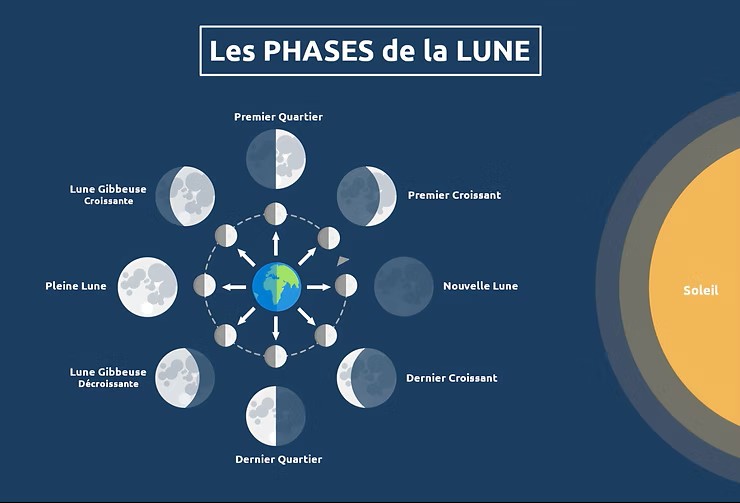
From an astronomical point of view, the full moon corresponds to the moment when the moon is opposite from the Sun in relation to the Earth. Its visible side is then fully illuminated. It is a measurable and predictable phenomenon, used for centuries as a temporal landmark in many societies.
The traditional name of this full moon: The wolf full moon
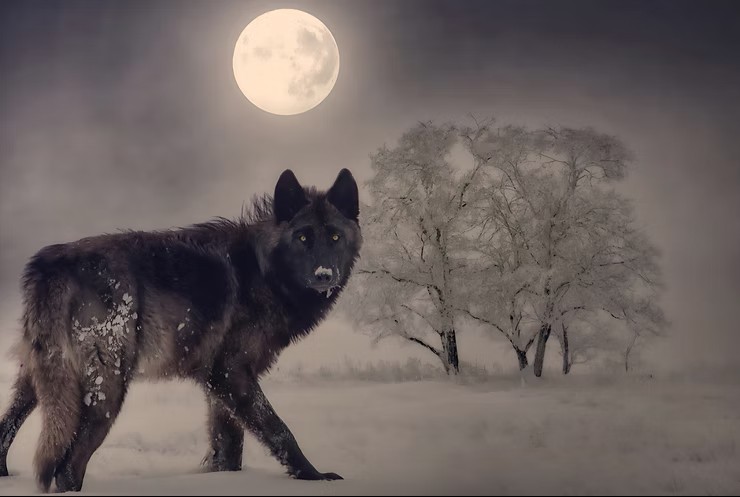
The first full moon of the year is traditionally called Wolf Moon (Wolf Moon). This name does not come from astronomy, but from North American traditions, transmitted by agricultural almanacs from the 18th century. It refers to an observable winter reality: in the heart of winter, the wolves were getting closer to inhabited areas and made themselves heard more. The name therefore evokes a period of cold, scarcity and survival, where the instinct and cohesion of the group were essential. On the symbolic level, this full moon is associated with: inner listening, instinctive lucidity, the ability to distinguish the essential from the superfluous. In the context of the beginning of the year, the full moon of the wolf invites less to agitation than to clarity: to look at what is really vital before embarking on a new cycle.
The first full moon of the year: why we attach meaning to it
Science describes celestial mechanics, but human beings have always attributed meanings to great natural cycles. In many cultures, the moon served as a founding rhythm: for agricultural seasons, parties, calendars, and transition moments.
The first full moon of the year has often been perceived as a threshold: a moment when we shed light on what is already there, rather than rushing into multiple resolutions. It invites you to observe, recognize, and decide.
Year One: The Symbol of Beginning
Why are we talking about a “year 1” for 2026?
When we call 2026 a year 1, we are not referring to an astronomical or scientific landmark, but to a symbolic reading from traditional numerology.
This reading is based on a simple principle, used since antiquity in different cultures:
We add the figures for the calendar year, then we reduce the total to a single digit.
For 2026:
2 + 0 + 2 + 6 = 10
1 + 0 = 1
It is this reduction that leads to speaking of year 1.
In numerological traditions (notably Pythagorean and their later legacies), the number 1 is associated with the beginning, the initiative and the initial impulse. It symbolizes the starting point of a cycle, before the structuring, development or consolidation which will come next.
It is important to remember that this reading is symbolic and cultural, and not predictive. It does not affirm anything about the events to come, but proposes a framework for reflection: that of a year placed under the sign of the initial choice, the direction given and the conscious movement.
In this context, speaking of “year 1” means asking a simple question:
not how many things to engage, but in which direction to take the essential.
The traditional symbolism of numbers, the one represents the origin, the unity, the initial impulse.
It’s time to start, but especially to choose. One does not yet speak of structure, expansion, or accumulation. He talks about a direction.
In other words: year one reminds us that the essential is not to multiply the objectives, but to choose a clear and coherent trajectory.
Year 1 and Period 9 Feng Shui: a coherence of cycles
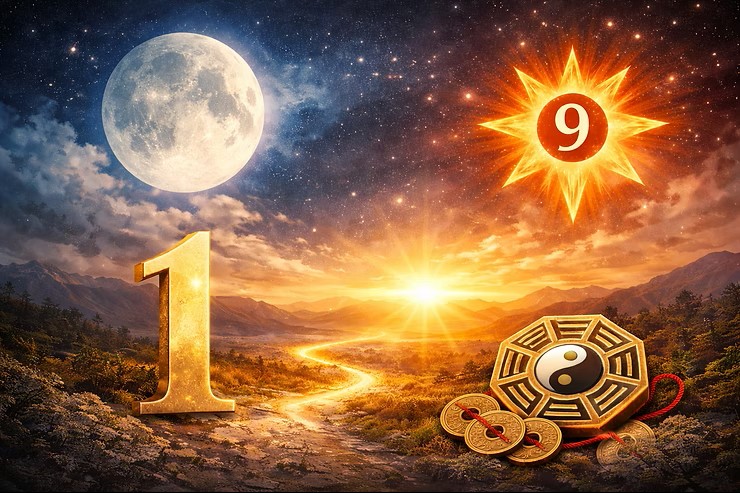
Since February 4, 2024, traditional Feng Shui has situates the world in what is called the 9th period, a twenty-year cycle associated with the Fire element and the notion of light, visibility and revelation. This change of period marks a collective shift, which influences the dynamics of places, activities and societies.
The reading of 2026 as year 1, resulting from traditional numerology, is part of another level: that of the annual and individual rhythm. It does not describe the global context, but the way in which everyone chooses to enter a new movement.
These two approaches do not belong to the same system, but they answer each other symbolically. Period 9 lays a setting made of exposure and increased clarity; Year 1 invites you to consciously decide how to get involved.
In both cases, it is a question of light, choice and direction given to the cycle that opens.
When the full moon meets the energy of departure
Symbolically, the full moon illuminates. the year an initiate. Together, they suggest the same attitude: clarify before accelerating.
This is a good time to ask yourself simple and useful questions:
What do I really want to start this year?
What do I repeat out of habit, but who no longer feeds me?
What should be brought to light, even if it is not comfortable?
Which single direction would be the fairest, here and now?
Simple rituals: symbolic gestures, not obligations
A ritual is not an obligation, nor a promise of automatic result. It is a symbolic framework to help the mind make a transition. If you like this type of practice, here are three sober, accessible proposals, and without unnecessary folklore.
Ritual 1: Clarification (10 minutes)
Take a sheet. Write two columns.
Column A: What I leave behind.
Column B: What I choose to take with me. Then read column B in a low voice, only once, calmly.
Ritual 2: The One Intention (3 minutes)
Choose a single intention for the year. A short, clear sentence, without justification. Examples:
“I choose consistency.”
“I choose stability.”
“I choose inner peace.” Note it. And keep it visible for a week.
Ritual 3: Silence and presence (5 minutes)
Without music, without guidance, sit down and simply observe. The objective is not to “succeed” a meditation, but to make you available to what is trying to emerge.
Conclusion
The first full moon of the year is neither magical nor binding. It’s a landmark. A moment when the light is maximum, therefore an ideal time to take stock: what begins, what continues, and the direction you want to choose.
The year one does not ask to run. She asks to decide.