We spend most of our lives inside: in our homes, apartments, offices, places of care or work. However, we rarely take the time to question the profound influence that these spaces exert on our balance, our health, our sleep and our emotional state.
Geobiology and Feng Shui offer a sensitive and global reading of our living spaces. These ancestral disciplines invite us to look differently at habitat, no longer as a simple container, but as a living space, crossed by energies, memories and subtle information. At Wellforlife, I integrate geobiology and Feng Shui into a global approach to well-being, in addition to hypnosis, magnetism and energy care. Because harmonizing the being without harmonizing the place often amounts to working halfway.
Geobiology: Listening to the energies of the Earth
Geobiology is interested in the influence of the environment on living things. It observes the interactions between the subsoil (water veins, faults, cavities), telluric networks, electromagnetic disturbances and naturally carrier or disturbing areas. The elders knew that some places favored life, rest, healing… and others weakened. They carefully chose the location of villages, temples, places of care or worship. Modern geobiology is part of this continuity of empirical knowledge transmitted by observation, experience and feeling.
Already, more than 2000 years ago, Hippocrates, the father of medicine, affirmed that to be in good health, four factors had to be considered: the constitution of the individual, the air, the water and… the condition of the basement. Our ancestors, from the builders of cathedrals to the Romans, passing through the Celts, had an intuitive knowledge of these energies. They knew how to choose the most favorable locations to build their places of worship, their cities and their dwellings.
Land networks and areas of influence
In geobiology, we often speak of telluric networks: natural energy grids that crisscross the surface of the Earth. In the 20th century, researchers like Dr. Ernst Hartmann and Manfred Curry highlighted the existence of these geomagnetic networks. The Hartmann network, oriented north-south and east-west, and the Curry network, diagonally, are the best known. These “walls” of invisible energy can, at their crossings, create geopathogenic points, that is to say potentially harmful to health if one stays there for a long time.
| Network | Orientation | Origine | Potential health impact |
| Hartmann | North-South / East-West | Nickel | Sleep disorders, chronic fatigue |
| Curry | Diagonal (Ne-So/No-Se) | Iron | pain, inflammation |
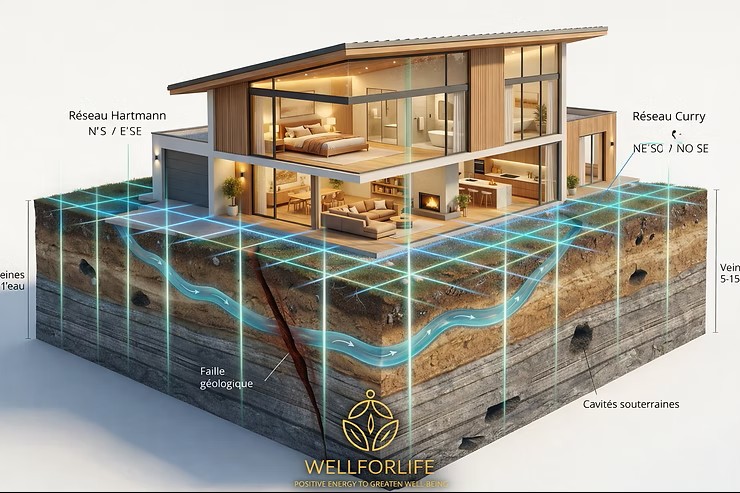
Some crosses can become uncomfortable when you stay there for a long time, especially for sleeping or working. Without going into excessive technical considerations, the main thing is to understand this: a place can support vitality… or on the contrary tire it. The role of the geobiologist is to identify these areas and to propose simple adjustments: movement of a bed, reorganization of a space, energy harmonization.
Lyon: a remarkable energy and spiritual continuity
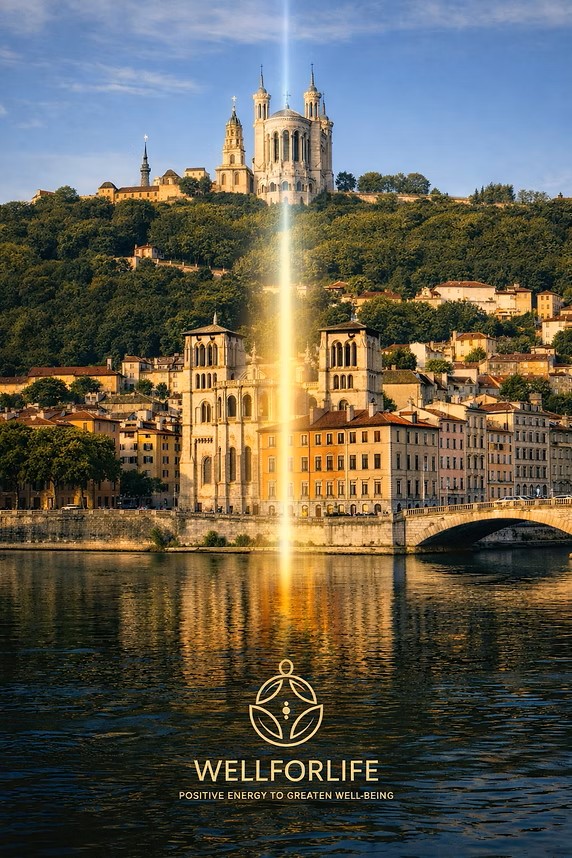
Lyon is an example particularly telling of this relationship between territory, history and energy. The hill of Fourvière, long called the praying hill, has always been a central place: first for Celtic cults, then Romans, then Christians. This continuity is not insignificant: it testifies to a place perceived, at all times, as a bearer of protection, fertility and reliance.
The sacred geography of Fourvière and Saint-Jean
The sacred geography of Lyon is particularly fascinating and revealing of this energy continuity that crosses the millennia. The Fourvière hill forms a powerful energy axis with the primatiale Saint-Jean-Baptiste, located just below, on the banks of the Saône. This vertical alignment is not insignificant: it connects the celestial energy of Fourvière to the terrestrial and aquatic energy of Saint-Jean, creating a unique vibrational balance in the heart of the city. Many currents of sacred geography consider this alignment as a symbolic balance between earthly and celestial forces.
Between these two major energy poles, rue du Bœuf plays a symbolic and energy connector role. Drawn at the end of the 3rd century, this street connects the inhabitants of the high hill of Fourvière which, deprived of water supply, had to descend towards the Saône to establish the district of Vieux Lyon. Historically, this street would have been the processional path linking the two major energy levels of the city. Its name, which comes from a bull statue placed in the 16th century by the doctor Louis Thorel, hides a deeper meaning: the bull, an animal of strength and power, symbolizes the vitality that circulates between heaven and earth.
The succession of the mother goddesses: Matrae, Cybele, Mary
Fourvière hill, formerly called Forum Veneris (the Venus Forum), was much more than just an administrative center: it was a major energy center in the Roman colony of Lugdunum. But even before Venus, the hill was already a sacred place of worship. In Celtic times, the great Mother Goddess, in the form of the Matrae (Celtic Mother Goddesses), was venerated on this site. These goddesses embodied creation, protection, fertility and healing. They were the guardians of life, the protectors of families and births.
Then, from 160 Apr. J.-C., the Romans established a great sanctuary there dedicated to Cybele, the Phrygian goddess, the “Magna Mater” (Great Mother of the Gods). Taurobolic altars discovered in 1704 and preserved in the Gallo-Roman museum of Fourvière bear witness to the importance of this cult. These altars commemorated the ritual sacrifices offered to Cybele for the prosperity of the colony and the health of the Emperor. Cybele, like the Matrae before her, embodied creation, protection, fertility and healing. She was the goddess of wild nature, fertility, and she could cure diseases. His cult was one of the most important of the Roman Empire, practiced by the elites and the people.
This succession of mother goddesses – from the Celtic Matraes to the Roman Cybele, then to the Christian Virgin Mary – reveals a remarkable energy continuity: the hill of Fourvière has always been a center of sacred feminine energy, creation and protection. Before the current basilica, the site hosted sanctuaries dedicated to female deities, to the Great Mother, to Cybele. These places were built by builders who knew how to feel, observe and integrate the invisible forces of the territory.
Saint-Jean Cathedral: a place of energy
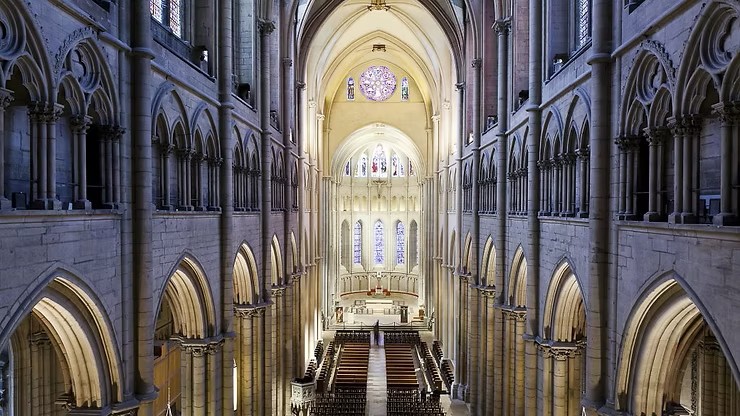
The St. John’s Cathedral itself, built over several centuries from 1175, is a masterpiece of Romanesque and Gothic architecture. Much more than a simple religious building, it is a place of energy, a meeting point for the forces of heaven and earth. The former architects developed within it places where the link between oneself and the sacred was possible. The cathedral has energy charging and discharge points, as well as energy paths allowing everyone to achieve a real interior transformation.
Some speak of the seven main columns of the cathedral as corresponding to the seven major chakras of the energy body, allowing pilgrims to heal themselves by circulating in these sacred spaces. This energy architecture reflects a deep understanding of the invisible forces that animate the universe. The ancient builders knew that certain places favored healing and spiritual transformation, and they encoded this knowledge in stone, in proportions, in orientations.
Feng Shui: Circulate the vital breath
Feng Shui, which literally means “wind and water”, is a thousand-year-old Chinese art that aims to harmonize environmental energy, the famous Qi (or Chi), to promote health, well-being and prosperity. Just like geobiology, Feng Shui assumes that our environment is traversed by energy flows that are constantly influencing us.
Feng Shui is the art of harmonizing the circulation of Qi, vital energy, in a place. It is based on several fundamental principles: the balance between Yin and Yang, the dynamics of the five elements (wood, fire, earth, metal, water), and the relationship between orientation, shapes, materials and uses. A good Feng Shui does not seek aesthetic perfection, but a fluid circulation of energy, adapted to the inhabitants and their way of life.
The most striking parallel between Geobiology and Feng Shui is undoubtedly the importance given to underground watercourses. In geobiology, sleeping on a water vein is considered very harmful. In traditional Feng Shui, the “veins of the dragon” are powerful energy currents that you have to know how to capture and orient, but never undergo in a passive way. This is exactly what the former builders of Lyon understood by placing the altars of their churches on crossings of underground energies.
Memoirs of places: when history is part of space
Beyond the purely telluric aspects, many places carry energy memories. These memories are linked to lived events, repeated emotions, human stories that have been inscribed in time. A house is never neutral. She saw joys, sorrows, conflicts, sometimes illnesses, sometimes dramas pass. These experiences can leave a subtle, noticeable imprint for some people.
It thus happens that occupants feel a discomfort in a specific room, unexplained fatigue, sleep disturbances that appeared after moving in, or a feeling of heaviness or oppression. In energetic traditions, we then speak of the memory of the place. This is why some houses seem immediately welcoming, while others seem heavy or oppressive, even empty.
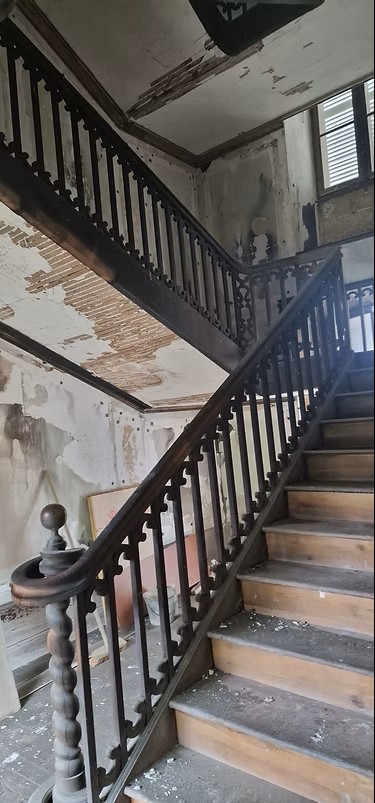
Subtle entities and presences: a traditional reading
Some ancient traditions also evoke the presence of forms of consciousness linked to places: spirits, presences, guardians, souls linked to a space. These notions exist in many cultures and are an integral part of traditional geobiology. In practice, these situations remain rare, but they can manifest themselves in very old buildings, abandoned or long uninhabited places, spaces marked by strong events.
The approach is never based on fear. It is not a question of fighting, but of pacifying, of liberating what no longer has to be, and of allowing instead to find a neutral and living energy. To harmonize a place is sometimes also to close a chapter, to allow a new story to be written.
The influence of the former inhabitants
The inhabitants themselves leave a trace. Emotions experienced intensely and durably — stress, anger, sadness, anguish — can permeate a place. This is why it is important to energetically clean up a space before moving in, or to reharmonize it regularly to maintain a positive and lively atmosphere.
The WellforLife approach: harmonize the place to support the being
With WellforLife, my approach is global and respectful. I analyze the geobiological aspects, the energy circulation, the possible memories, and the relationship between the place and the people who occupy it. I deeply believe that to regain your inner balance, it is essential to evolve in a healthy and harmonious environment.
I work both in homes and in offices, law firms, private clinics, companies, factories, restaurants, industrial or commercial buildings. Whether you feel a diffuse discomfort, you suffer from sleep disorders, want to improve the productivity and well-being of your employees, or just want to make your space a real haven of peace and vitality, I can help you.
I analyze your place of life or work to detect any disturbances (telluric networks, streams, faults, electromagnetic pollution) and I offer you concrete and personalized solutions to neutralize them. I also advise you on the layout of your interior or your professional premises according to the principles of Feng Shui, so that the energy circulates freely and nourishes you on a daily basis.
The benefits observed after harmonization are often rapid: improvement in sleep, emotional calming, feeling of security, better concentration, renewed energy. A harmonized space becomes a support, a refuge, an ally in your daily life.
Conclusion
Taking care of your place of life is taking care of yourself. A harmonized space becomes a support, a refuge, an ally.
Do not wait any longer to take care of your place of life, it is a reflection of your inner world. At Wellforlife, I accompany you so that your place becomes a space of balance, vitality and inner peace.
Contact me for a personalized study of your place and discover how geobiology and feng shui can transform your environment and well-being.